


The Universal Adapter: How the Model Context Protocol (MCP) Connects AI to the Physical World

Updated: Aug 7
Over the past few weeks, we’ve systematically broken down the architecture of modern enterprise AI. We established the foundational blueprint in Deconstructing AI, zoomed into the core matrix-math in Deconstructing the Brain, explored how static intelligence becomes autonomous in The Agentic Control Loop, and mapped out multi-agent collaboration in Deconstructing the Swarm.
But despite all this advanced architecture, there is still one massive, glaring hole.
An autonomous agent running a continuous state machine is ultimately useless if it cannot securely read a database, execute a CLI command, or push a payload to a cloud controller. Without a way to interface with enterprise infrastructure, the agent is trapped in a vacuum—all thought and no action. To interact with the physical world, AI agents need to talk to your existing systems.
What is an API?
An Application Programming Interface (API) is a rigid, mathematical contract that allows two pieces of software to communicate. Whether it is REST, gRPC, or GraphQL, an API requires extreme precision. If an application wants to query an makemytrip's database for flight/hotel availability, it must hit a highly specific URL endpoint, pass a securely encrypted authentication token, and format the request in a perfectly structured JSON schema. If a single comma is out of place, the API rejects the request with a 400 Bad Request error.
Why APIs Break AI Agents
Large Language Models (LLMs) are probabilistic reasoning engines. They do not natively know the thousands of API endpoints required to accomplish a task.
Before MCP, if you wanted your AI Agent to pull data from multiple disparate systems—like an airline reservation system, a hotel reservation system, and a payment gateway to pay for bookings —a human developer had to write custom "glue code" for each one. The developer had to write a Python script that took the AI's general intent, wrapped it in the exact API formatting, injected the secret API keys, executed the request, and then parsed the JSON response back into text the LLM could read.

This created two fatal flaws for enterprise architectures:
The N-Squared Integration Nightmare: If you have an orchestrator managing specialized Flight, Hotel, L2, and L3 agents across dozens of enterprise platforms, your engineering team now has to write, update, and maintain bespoke API connectors for every single interaction. It becomes an unscalable maintenance burden.
The Security Vulnerability: To let an AI script execute an API call natively, you must hand over your API keys, database credentials, and network access rights directly to the AI's execution environment. Whether it is a B2C booking platform holding credit card data or a production SaaS environment managing core network switches, giving a generative AI model direct access to your authentication tokens is a catastrophic InfoSec violation. Enter MCP: The Universal Adapter
The Model Context Protocol (MCP), recently open-sourced by Anthropic, fundamentally shifts this paradigm. It completely decouples the AI reasoning engine from the physical API execution environment.
Instead of teaching the AI agent how to speak 50 different APIs securely, you teach it to speak one protocol: MCP.
How MCP Fixes the API Problem
When an agent (acting as an MCP Client) connects to an MCP Server, the server acts as an intelligent proxy. It exposes three distinct capabilities to the agent using a standardized JSON-RPC handshake:
Resources: Static or dynamic data that the agent can read.
Prompts: Pre-configured templates that help the agent format its requests.
Tools: Executable functions that allow the agent to take action.
Because MCP is an open standard, you write an MCP Server once. After that, any agent framework (LangChain, AutoGen, CrewAI) that supports the protocol can instantly use those tools without a single line of custom API glue code.
Example 1: The Multi-Agent Travel Symphony
Let’s see how MCP replaces raw API calls in our B2C travel scenario.
"Book me a flight and hotel from Chennai to Mumbai, 15–18 March."
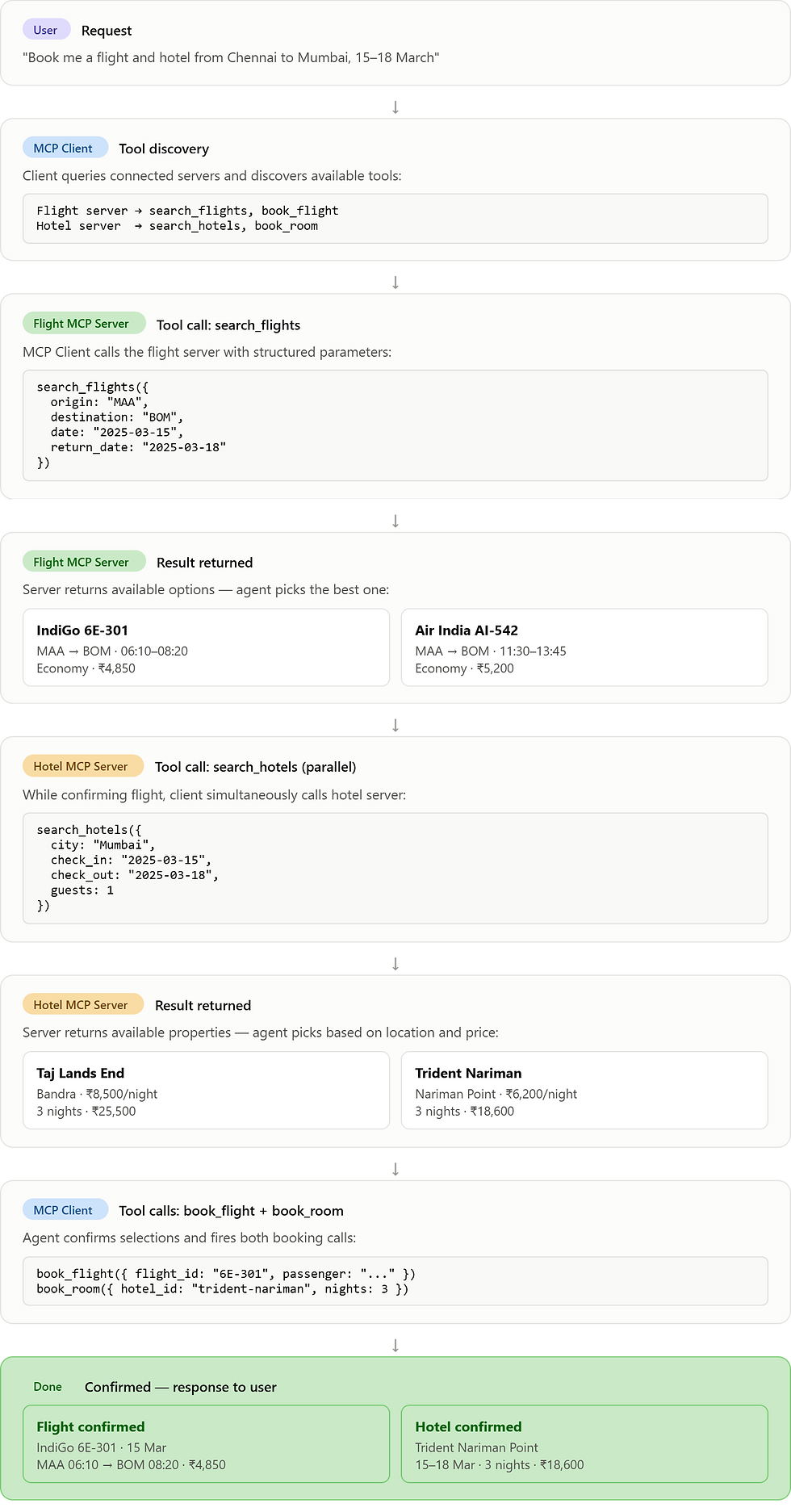
Phase 1: Tool Discovery
The Orchestrator Agent (MCP Client) receives the prompt and immediately queries its connected infrastructure to understand its capabilities.
It polls the Flight MCP Server, discovering the tools search_flights and book_flight.
It polls the Hotel MCP Server, discovering Google Hotels and book_room.
Phase 2: Parallel Tool Execution (The Search)
The AI reasoning engine parses the user's intent into structured JSON and fires off simultaneous execution requests.
1. The Flight Query: The Client sends a payload to the Flight MCP Server:
JSON
search_flights({
  "origin": "MAA",
  "destination": "BOM",
  "date": "2025-03-15",
  "return_date": "2025-03-18"
})
The Flight Server executes the secure backend API call and returns the options: IndiGo 6E-301 (₹4,850) and Air India AI-542 (₹5,200).
2. The Hotel Query (In Parallel): While the flight is being confirmed, the Client simultaneously pings the Hotel MCP Server:
JSON
search_hotels({
  "city": "Mumbai",
  "check_in": "2025-03-15",
  "check_out": "2025-03-18",
  "guests": 1
})
The Hotel Server returns the available properties: Taj Lands End and Trident Nariman.
Phase 3: The Action (Confirmation & Handoff)
The agent's internal logic selects the optimal combination (e.g., IndiGo 6E-301 and Trident Nariman). It now moves from "read-only" searches to physical state changes by firing the final transaction tools:
JSON
book_flight({ "flight_id": "6E-301", "passenger": "..." })
book_room({ "hotel_id": "trident-nariman", "nights": 3 })
The Security Boundary: Notice what didn't happen here. The MCP Client never saw the airline's GDS API keys, nor did it handle the secure payment gateway tokens for the hotel. The isolated MCP Servers held the secrets, executed the raw REST API calls securely on their end, and simply returned the final confirmation hashes to the agent to present to the user.
Example 2: AI-Driven Network Diagnostics with NMS
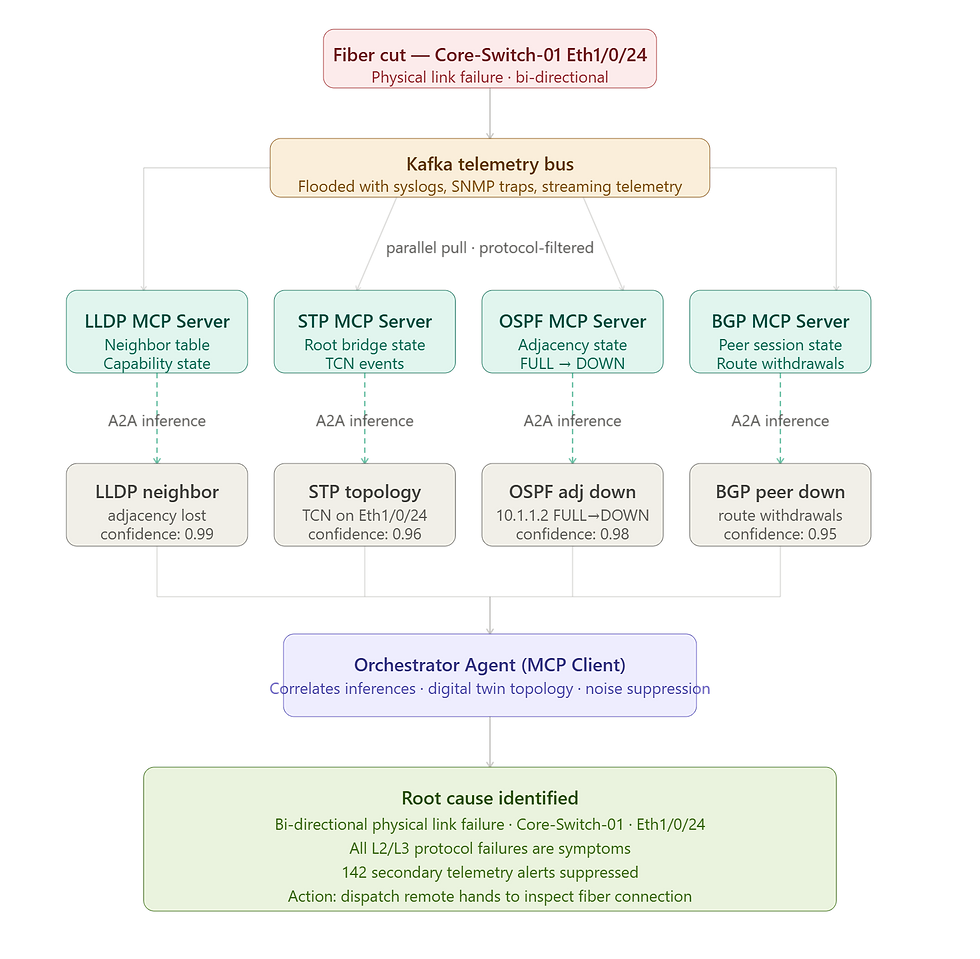
Each protocol gets its own dedicated MCP Server — LLDP, STP, OSPF, and BGP each pull only their relevant telemetry from Kafka and apply deep protocol-specific reasoning (the OSPF server understands the FULL → DOWN state machine, the STP server understands TCN events, and so on).
They all fire their structured inferences in parallel via A2A back to the Orchestrator, which does the one thing a monolithic agent can't — it spatially correlates four independent signals against the network's digital twin, recognizes they all share the same physical path and timestamp, suppresses 142 noisy secondary alerts, and outputs a single crisp root-cause directive.
Over the last few weeks, we have charted the complete anatomy of modern enterprise AI.
We started with the static reasoning of the LLM. We wrapped it in an Agentic Control Loop to give it memory and state. We connected multiple agents together using the A2A Protocol to form intelligent swarms. And today, we deployed the Model Context Protocol (MCP) to give that swarm secure, standardized hands to manipulate the physical world, permanently solving the API integration bottleneck.
This is no longer theoretical. This stack—LLMs, Agents, A2A, and MCP—is rapidly replacing legacy automation scripts, redefining how we approach CI/CD, network diagnostics, and cloud operations. The era of the autonomous enterprise is here.
Practical Resources & Further Reading
If you are an engineering leader or developer ready to implement these standards, start here:
The Official Model Context Protocol Documentation: Anthropic's official hub for the open-source specification, including architecture deep-dives and implementation guides.
MCP Server Reference Implementations: A massive open-source repository of pre-built MCP servers for tools like PostgreSQL, GitHub, AWS, Kubernetes, and Slack.
LangChain & MCP Integration: Documentation on how to natively configure LangGraph agents as MCP clients to consume external tools securely.
Building Secure AI Applications with MCP: The architectural announcement detailing how the Client-Server model prevents prompt injection attacks from exfiltrating local system data.


Comments