


The Agentic Control Loop: How AI Agents Execute Autonomous Actions

Updated: Aug 7
In my foundational piece, Deconstructing AI, I laid out the high-level architecture of how Large Language Models, Agents, and MCP servers interact. Then, last week in Deconstructing the Brain, we zoomed all the way in. We cracked open the LLM itself to reveal its structural reality: a frozen file of billions of numerical parameters processing data via pure matrix math.
We saw how an LLM acts as an incredible static reasoning engine, taking a prompt and outputting a highly predictable, structured blueprint. But a blueprint is just ink on paper.
By itself, a static LLM file cannot browse the internet, update a database, patch a failing network socket, or provision a Kubernetes pod. It has no state machine, no memory of past actions, and no native ability to execute code.
This week, we bridge that gap. We are exploring the Agentic Control Loop—the software architecture that takes the raw output of an LLM and uses it to drive dynamic, autonomous, real-world systems. Drawing from my current focus on designing AI-driven Quality Engineering architectures, let's break down exactly how these agents operate at enterprise scale.
What is an Autonomous Agent?
If an LLM is a detached "brain," an Agent is the entire body. In software engineering terms, an Agent is an architectural pattern that wraps an LLM inside a continuous control loop backed by memory, state management, and tool-execution frameworks.
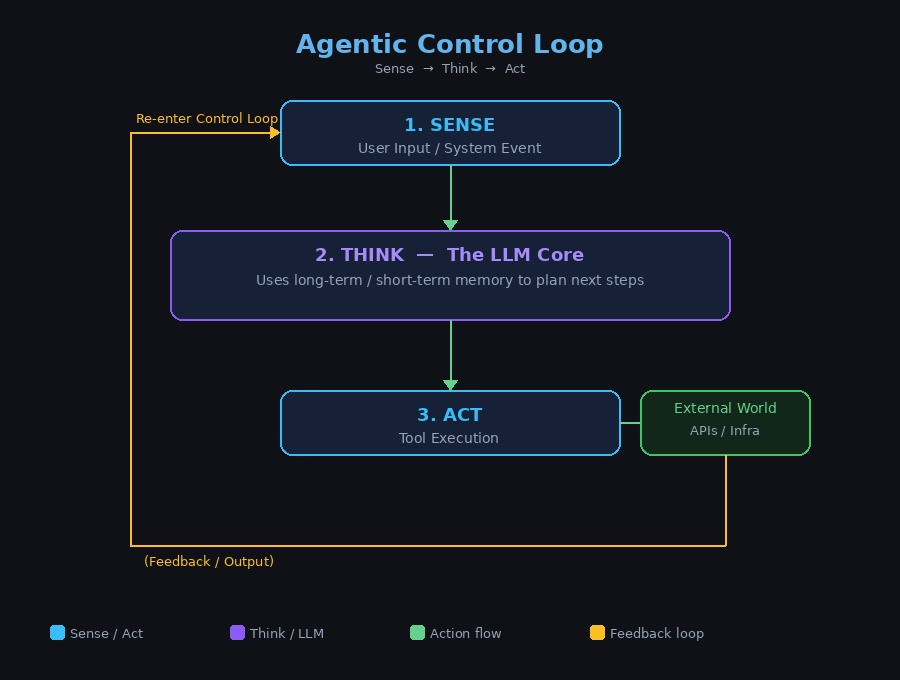
Instead of a single "one-and-done" prompt-and-response, an agent runs an infinite while loop (often referred to as an Asynchronous Agentic Loop). It continuously cycles through three distinct phases: Sense, Think, and Act.
To make this tangible, we will look at exactly two production blueprints: a Multi-Agent Travel Network and a deep dive into a Cloud-Native Quality Engineering SaaS.
Example 1: The Multi-Agent Travel Symphony
To understand how agents interact, let's look back at our travel booking request:
"Book me a flight and hotel from Chennai to Mumbai, 15–18 March."

When an Orchestrator Agent receives this prompt, it doesn't try to run every task on its own. It uses its Control Loop to instantiate a collection of specialized sub-agents:
The Orchestrator spins up a Flight Agent and hands it the parameters Origin: MAA, Dest: BOM, Date: March 15. The Flight Agent drops into its own loop, executing local search tools to query Global Distribution System (GDS) APIs, returning the optimal flight options back to the Orchestrator.
Concurrently, a Hotel Agent enters a loop to query Property Management Systems (PMS) in Mumbai for those exact check-in dates.
Once both sub-agents return their text-based validation states, the Orchestrator passes the aggregated totals to a secure Payment Agent, which triggers a final transactions tool via a paytm or Razorpay MCP server to finalize the bookings.
The orchestration framework manages the concurrency, error boundaries, and state transitions across all three systems seamlessly.
AI-Driven Network Diagnostics
Having spent years managing and supporting networks, debugging protocol failures, and validating software solutions to monitor them, I know firsthand that in networking, a single failure never generates a single alert.
When a physical cable is cut, a legacy Network Management System (NMS) will flood the network operations center with a massive telemetry storm. A single Link Down event instantly triggers a cascade of secondary failures:
LLDP / CDP adjacencies drop.
Spanning Tree (STP) detects a topology change and recalculates.
OSPF / BGP neighbor adjacencies fail due to dead timers.
Route flushes propagate across neighbor and remote nodes.
Suddenly, the dashboard is flashing red with 50 different "Critical" protocol alerts. A human engineer has to manually sift through the logs and correlate them to realize that all these failures point back to a single physical port going dark.
Here is how we solve this by building a cloud-native, microservices-based SaaS NMS powered by an agentic architecture.
The Core Infrastructure Architecture
To ingest this telemetry storm without dropping packets, we use an event-driven, loosely coupled microservices topology.

The Ingestion Service: A high-throughput microservice that accepts streaming telemetry (syslog, SNMP traps, streaming telemetry) and pushes it to our message backbone.
The Message Backbone (eg:Apache Kafka): Messages are published to a high-partition Kafka topic named telemetry.raw. Kafka acts as our shock absorber during a telemetry storm.
Vertical & Horizontal Scaling: The agent worker pods consume from Kafka. If a massive network outage occurs and Kafka Consumer Lag spikes, our Kubernetes Horizontal Pod Autoscaler (HPA) instantly spins up new replica pods to process the alerts in parallel. Our Postgres database, partitioned by tenant_id for SaaS isolation, scales vertically to handle the heavy indexing.
Entering the Loop: The Correlation Engine
Instead of dumping 50 alerts onto a dashboard, our SaaS platform utilizes a hierarchy of LLM-backed Agents to process the Kafka stream.
We deploy specialized sub-agents: an L2 Agent (watching STP/LLDP) and an L3 Agent (watching OSPF/BGP). Above them sits the Root Cause Orchestrator.
When the fiber cut happens, here is how the Orchestrator enters the Sense-Think-Act loop:
Plaintext

Step 1: Sensing the Storm
The Orchestrator agent reads a batch of messages from its sub-agents: OSPF neighbor 10.1.1.2 is down. STP Topology Change Notification received. LLDP neighbor lost on Core-Switch-01.
Step 2: Thinking (Function Calling)
The agent framework packages these events and inputs them into the LLM context window, along with a Vector DB retrieval of the network topology.
The LLM's internal matrices correlate the timestamps and the topology map. It realizes that the OSPF neighbor, the LLDP peer, and the STP interface all share a physical path: Interface Ethernet 1/0/24.
The LLM decides it needs to verify the physical layer. It outputs a JSON Tool Call:
JSON
{
  "tool_to_call": "execute_switch_api",
  "arguments": {
    "device_hostname": "Core-Switch-01",
    "command": "show interface Ethernet 1/0/24 status"
  }
}
Step 3: Acting Autonomously
The Go agent framework intercepts this JSON output and runs the physical tool. It makes a REST API call to Core-Switch-01 and retrieves the output: Eth1/0/24 is DOWN (Link failure/Loss of Sync).
The result is appended right back into the prompt window. The agent senses this new data, closes the loop, and takes its final action. Instead of paging an engineer with 50 confusing protocol alerts, it suppresses the noise and generates a single, highly accurate Jira ticket or Slack message:
Root Cause Identified: Physical link down on Core-Switch-01, Eth1/0/24. This has caused the subsequent OSPF, LLDP, and STP failures. Suppressing secondary alerts. Dispatch remote hands to check fiber connection.
The LLM didn't run the API call natively; it provided the structured reasoning that forced our software control framework to investigate the network and find the true anomaly.
The Architectural Horizon: What's Next?
The true power of AI doesn't come from a text model guessing the next word in a chat box. It comes from the engineering layers we build around that model. By turning a static matrix-math pipeline into an active, stateful engine, we shift from passive text generators to resilient software systems capable of managing massive, distributed data center networks.
Now that we have covered how an individual agent uses control loops and tool calls to interact with networks and infrastructure, we can explore how these independent systems find and collaborate with each other. In my next piece, I will look at the global networking standard driving distributed AI computing: The Agent-to-Agent (A2A) Protocol. Stay tuned.
Practical Resources & Further Reading
If you want to move beyond the theory and see how these infrastructures are built in production, check out these developer-focused resources:
LangGraph Framework by LangChain: A premier open-source development library designed explicitly for building stateful, multi-agent networks using cyclical graphs and structured control loops.
Introduction to Function Calling (Hugging Face Guide): A practical, hands-on software guide detailing how to prompt and format open models to guarantee deterministic JSON tool outputs.
Apache Kafka: Building Data Pipelines: Confluent's architectural guide on decoupling microservices and managing high-throughput event streaming safely during telemetry storms.
Netmiko & NAPALM for Network Automation: The industry-standard Python libraries for building the physical "Tools" your AI agents will use to securely execute CLI commands and API calls against multi-vendor network switches.
Kubernetes Horizontal Pod Autoscaling (HPA) with Custom Metrics: The official Kubernetes documentation on configuring autoscalers based on external metric pipelines like Kafka consumer lag.


Comments